J1939 Data Logger for AI Fuel Consumption Analysis
Case Studies / FuelRe4m

FuelRe4m
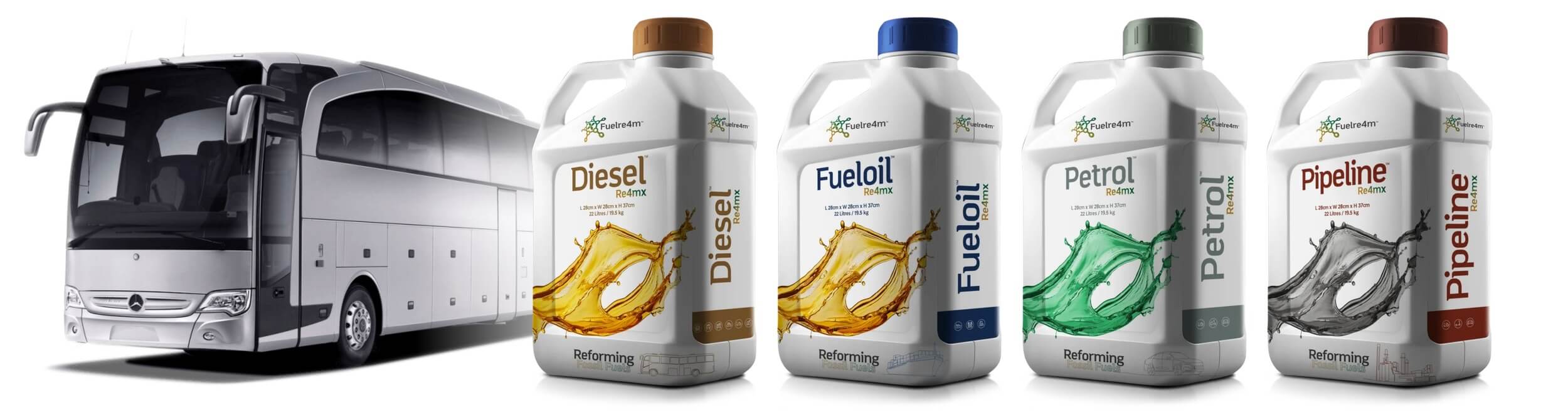
FuelRe4m develops Re4mx fuel reforming technology that improves fuel efficiency and reduces emissions across transport fleets, quarry equipment, and marine vessels.
What problem did you solve?
The fuel industry has long relied on assumption-based reporting. Real combustion data is often unavailable, locked behind manufacturer systems, or abstracted into estimates. For companies reforming fuel, this lack of visibility is a barrier to trust. Without engine-level data, performance claims remain unverifiable. FuelRe4m needed a way to collect real-world combustion performance across multiple sectors and platforms, using a standardised, repeatable methodology.
How did you solve it?
FuelRe4m selected CSS Electronics' CANedge3 as its go-to tool for performance validation. Trials were structured around controlled baselines. Vehicles were first monitored running standard fuel. Re4mx was then introduced, and operations continued over the same loops. Engineers compared before-and-after data to quantify improvements. Data points included fuel flow rate, engine RPM, vehicle speed, engine load, torque output, and exhaust temperature. This system was used across transport fleets, quarry and mining vehicles, and marine vessels.
On the backend, FuelRe4m has partnered with Five9nes as their digital solutions partner to build VIRDIS, an AI-driven platform for real-time data ingestion, predictive analytics, and intelligent supply chain automation.

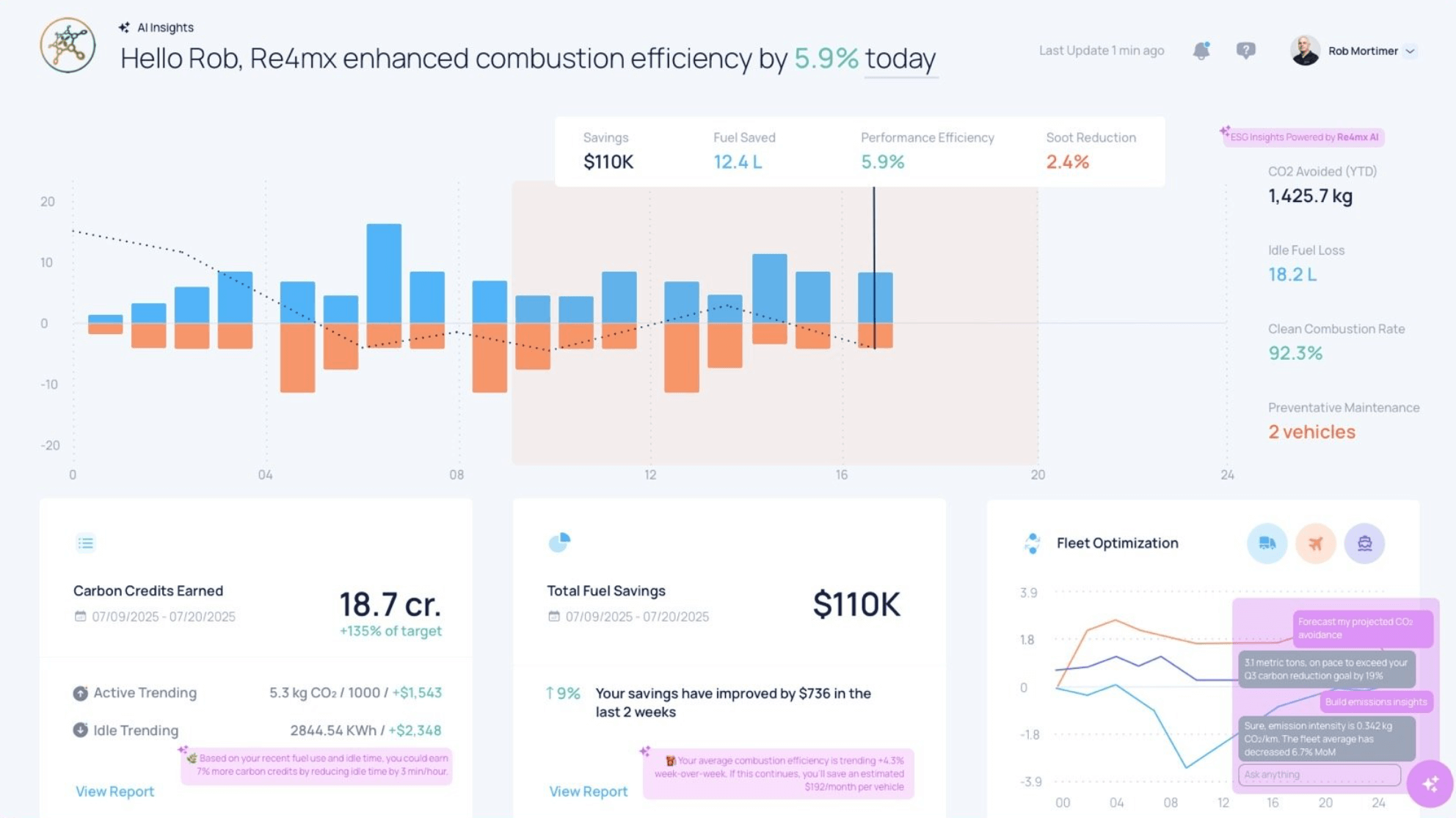 Fuelre4m's AI-powered distribution system, VIRDIS, has been developed in
partnership with Five9nes.io to support global deployment of Re4mx
Fuelre4m's AI-powered distribution system, VIRDIS, has been developed in
partnership with Five9nes.io to support global deployment of Re4mx

Specifically, the workflow looks as follows:
- Data capture: CANedge devices are configured to log selected high-resolution CAN/J1939 signals relevant to engine and vehicle operation. Data is recorded with full timestamps and transferred off-device for analysis
- Secure ingestion: Logged files are uploaded to a secure backend environment for storage and processing. Basic validation checks are applied to ensure file completeness and integrity before analysis
- Standardisation & preparation: Incoming data is standardised to a common internal format to allow comparison across vehicles, engines, and test periods. Time alignment and unit consistency checks are applied where required
- Automated pre-processing: The data is filtered and segmented to remove obvious non-representative conditions (e.g. incomplete records, corrupted signals). The objective at this stage is to ensure that only technically comparable data is passed forward for analysis
- Analysis environment: Prepared datasets are then evaluated using a combination of automated analytics and model-assisted review. The focus is on identifying repeatable changes in engine and vehicle behaviour across comparable operating conditions, rather than relying on single headline signals
- Reporting: Results are summarised into clear technical outputs suitable for validation, reporting, and independent review. All outputs include context on data coverage and limitations
"With Re4mx and CANedge working together, every outcome is proven, every claim is evidenced, and every litre is accounted for. Reforming fuel should not be estimated. It should be proven."
What benefit has this led to?
Across 500+ hours of engine operation, FuelRe4m recorded fuel savings between 15% and 20%, exhaust temperature reductions of up to 18°C, and lower soot and particulate output. Benefits include data-backed fuel savings validated at the source, flexible field trials managed without complex oversight, customers empowered to participate in the data process, and deep insight into fuel behaviour and engine response.
By syncing multiple CAN signals and analysing them at full resolution, Fuelre4m's AI models could isolate genuine changes in fuel utilisation that would not be visible via standard telematics summaries or OEM dashboard data.
In short, the CANedge3 enabled the distinction between apparent performance and real performance, providing the data fidelity required to validate fuel efficiency improvements under real-world operating conditions.
By capturing high-resolution, timestamped CAN data directly from the bus it's possible to see beyond the 'black box' and analyse actual combustion and fuel usage patterns. This is critical in validating real-world efficiency gains and separating genuine hardware/software changes from routine ECU control effects.
Modern engine ECUs apply extensive smoothing, filtering, and adaptive logic to fuel and performance signals. Instantaneous fuel rate, torque request, and load signals are often averaged over time, modified by transient compensation, and shaped by control strategies such as torque limiting, emissions management, and driveline protection. As a result, genuine changes in combustion efficiency can be masked by ECU averaging, redistributed across torque / fuel rate / speed - and may appear as 'normal' control behaviour rather than a measurable improvement.
The CANedge data logger allowed FuelRe4m to overcome these limitations by providing direct, high-resolution access to raw CAN signals in real time, with full control over:
- Which parameters were logged
- At what sample rate
- And under which operating conditions
This made it possible to:
- Analyse fuel consumption vs RPM, load, and torque demand rather than relying on single headline values
- Identify subtle but repeatable shifts in engine behaviour within dominant operating bands
- Separate true efficiency changes from ECU smoothing, averaging, and transient compensation effects
Why did you choose the CANedge?
FuelRe4m selected CANedge for its ease of use, open architecture, and compatibility across vehicle types. Its flexibility enables operators to collect performance data without specialist equipment or software, making it ideal for trials in complex or remote environments. A major benefit to clients is access to the CANedge software platform, included with every device.
— Peter Dorrel, Technical Project Manager
Ready to measure your fuel efficiency?
Get your CANedge today!